
How to help people (and AI) actually find your Squarespace website
SEO has been changing fast lately. It used to be purely about Google, how well Google could find you, and where you landed on the search results page. But with more people turning to AI tools there's a whole new category to think about. It's not just about ranking on Google anymore, it's about showing up on AI tools as well.
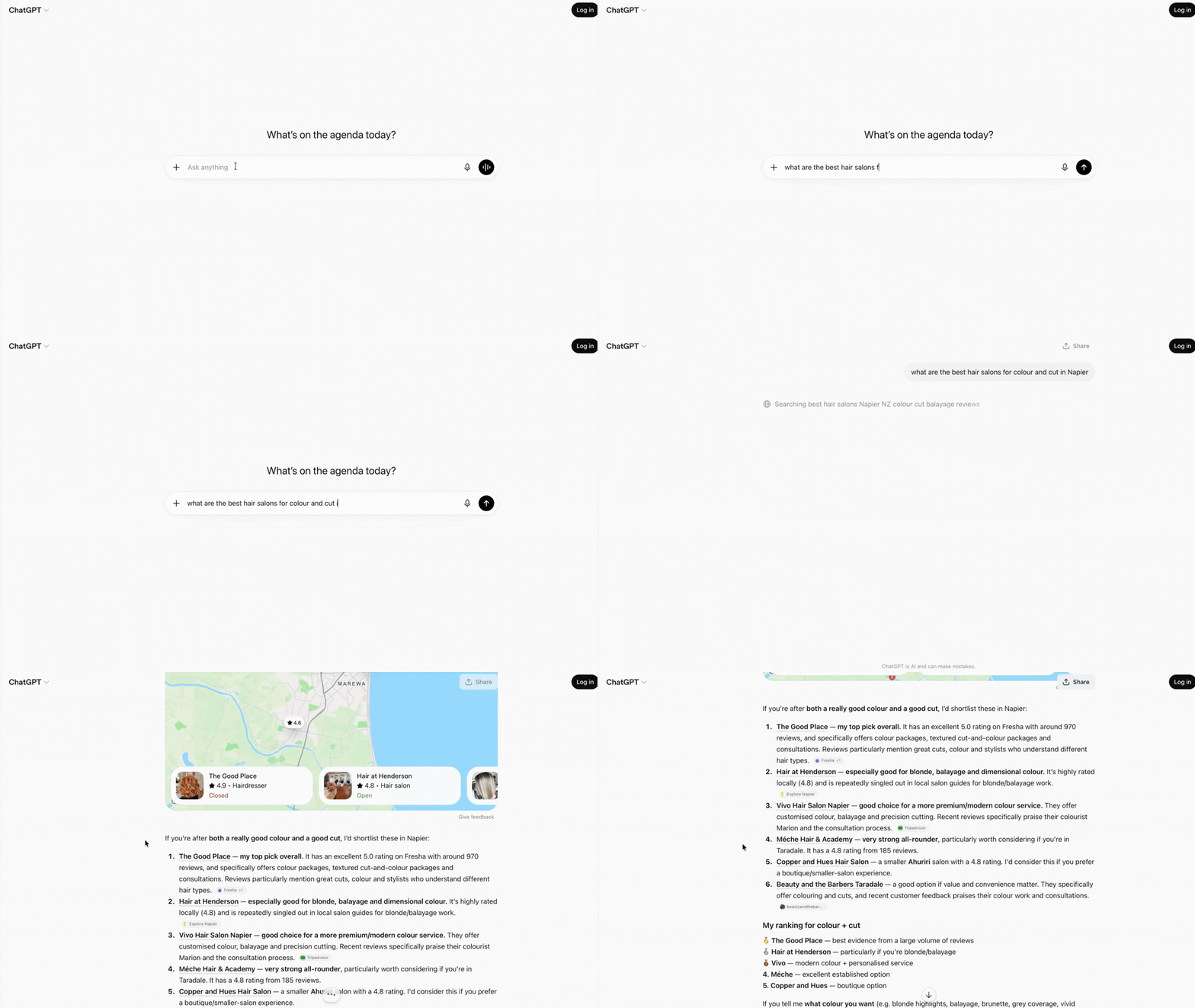
We've teamed up with Pip from Articulate Communications, our go-to for all things SEO, to put this guide together - and it covers a lot of ground. Pip kicks things off by busting the biggest myth right now, walks you through keyword research without the overwhelm and shares her practical tips for getting your copy, headings, metadata and FAQs working harder for you. Then I'll show you some key actions to take inside your Squarespace site.
Whether you've just launched your Pixi Site template or you've had your site for a while and want to give it some SEO love - this is the guide I wish existed when I was starting out.
The good news: Squarespace already does a lot for you
Squarespace takes care of a lot of the behind-the-scenes stuff automatically. Things like making your site secure, mobile-friendly and readable by search engines the moment you publish. You don't have to touch any of that - it’s all part of your Pixi Site Squarespace Website Template.
What it can't do is the personal, descriptive stuff - writing helpful page titles, describing your photos, creating content that actually answers people's questions. That's the part this guide walks you through. Sure, it requires a little work, but none of it requires any coding.

But first… a word from Pip
Before we get into the how-to, I wanted Pip to set the record straight on something. Because if you've been online lately, you'll have seen the noise… “SEO is dead, AI needs a whole different strategy, everything you've done doesn't count anymore”.
It's a lot. So I asked Pip to cut through the nonsense before we get into the practical stuff.
Here’s Pip’s top 8 SEO and AI tips for Squarespace websites
-
This is probably the thing I most want you to take away from this entire blog, so I'm putting it first.
When something new hits the digital marketing scene, a certain breed of marketer will trip over themselves to declare the old thing dead. Why? Because nothing sells a shiny new thing quite like discrediting the old thing. It's hype. And it's largely BS.
AI search tools (ChatGPT, Perplexity, Claude, Google's AI overviews) still need trustworthy, clear, well-organised information to pull from. Which means your SEO foundations are very much still alive. Get the basics right and you're not just ticking the SEO box - you’re ticking the AI box, too.
-
Before we get into keywords and metadata, let's start somewhere super basic. Can someone or something land on your homepage and immediately understand what you do, who you do it for and why they should care?
Not just a human. Google and AI (aka, the bots) too.
AI tools and search engines verify businesses by crawling your website. So your Homepage About intro section (that part where you've got a cute pic and a clever line or two about yourself) needs to do more than sound good. It needs to be clear.
Your personality-packed tagline might sound cute, but if Google and AI can't quickly work out what you actually do? They’re not going to recommend you.
Make sure your Homepage About intro answers 3 things: what you do, who you do it for and why they should choose you. You can absolutely still have the personality - just make sure the clarity is doing the heavy lifting.
Then pop down to your footer and check the same thing. Nobody's really reading your footer - but Google and AI absolutely are. It's a surprisingly useful spot to include clear, specific information about who you are, what you do and your location (if that matters). Don't waste it on just a logo and social links.
-
Here's the thing nobody tells you when you're trying to chuck together a website at 11pm with a glass of wine and a prayer: what you think your keyword is, and what your dream client is actually typing into Google, are often two very different things.
Keyword research sounds deeply unsexy. Kinda is, tbh - until you realise it's the thing that determines whether the right people actually land on your site, or whether you're just shouting into the void and wondering why your enquiry form or checkout is collecting dust.
Think like your client or customer
You know your industry inside out. Which means you probably use words your clients or customers don't. Your beautifully branded offer name, your industry jargon, your preferred terminology - none of that matters if your dream client is Googling something completely different. Start by asking: what would I type if I was them, knew nothing about what I do and just needed help?
Free keyword tools worth starting with:
Google Search autocomplete: start typing and see what it suggests. Real humans are behind every one.
People Also Ask: scroll down the results page for a goldmine of actual questions your audience is asking.
Google Search Console: if your site's been live for a while, this shows what people are already finding you for. Sometimes surprising.
Ubersuggest: free (with limits) and gives you search volume data without a paid subscription.
Keywords Everywhere: a browser extension that layers search data right into Google as you search.
When you're ready to get serious, check out SE Ranking.My go-to paid tool is SE Ranking. Accurate search volume, keyword difficulty, competitor data, AI overviews - alllll the good stuff. Worth the investment when you're ready to stop guessing and start knowing. But if it’s not in your budget, jump on the 14 day free trial to get you started.
One keyword. One page. That's the deal, OK
Each page gets its own specific keyword. One that gets woven naturally into the title, headings, copy and metadata. Which brings us nicely to the next bit...
-
WTF is metadata? Basically, it's the behind-the-scenes introduction your website gives itself to Google before anyone even clicks through. If yours is currently serving up 'Home' or 'About' you can absolutely do better.
Your meta title (also called a page title) helps Google work out where the page belongs. Your meta description helps the right human decide whether it's worth the click.
Here's where Squarespace can be a little sketchy: the character limits in the platform are way more generous than what Google actually displays. So you can type to your heart's content and find half of it gets cut off in search results.
Stick to these:
Meta title: 50–60 characters (spaces included) max
Meta description: 150–160 characters (spaces included) max
Do this for every page. Not just your homepage. And the words you use? Yip, the keywords I yapped on about back at the start.
Bonus tip. Use Word Counter to check your character count length.
-
Every page has one H1 (your main page heading). Google gives it a bitta weight when figuring out what the page is about, so your keyword needs to sit pretty in there. Keep it between 20–70 characters.
But sometimes? Your keyword is boring AF. 'Squarespace website templates' isn’t exactly exciting, is it? You've worked hard on your brand voice. You don't want your first impression to sound like a Yellow Pages listing.
So here's a workaround I use when writing deliciously on-brand website copy: turn your H1 into eyebrow text (a smaller line that sits above what ‘appears’ to be your main heading). It does the SEO heavy lifting quietly in the background, while your H2 (which displays bigger and bolder) is the line your reader actually feels first.
People don't read websites top to bottom like a book - their eyes scan and often go straight to the biggest, boldest thing on the page. So if your H2 is doing the connecting and your H1 is helping you get found, you get both. Findable and relatable.
Example:
SQUARESPACE WEBSITE TEMPLATES FOR SMALL BUSINESSES ← H1 (eyebrow - smaller, sits above)
Betcha trying to design a website wasn’t on your bingo card this month ← H2 (bigger, bolder - what the reader actually clocks first)
The reader feels the H2. Google clocks the H1. Happy days.
-
FAQs aren't just a nice-to-have. They're doing 3 important jobs at once.
For the humans reading your page: FAQs reduce friction. Answer the question someone's already thinking: 'how does this work?', 'what does it cost?', 'how long does it take?' and they're a whole lot more likely to reach out. It's the difference between someone clicking away because they weren't sure, and someone hitting ‘let’s do / buy the damn thing’ because you've already put their mind at ease.
For Google: FAQs are packed with the plain, conversational language that matches how people actually search. Short question, direct answer - Google loves it and will often pull FAQ content into search results directly.
For AI tools: Like Google, AI search tools pull answers from websites that give clear, trustworthy, specific information. A well-written FAQ is basically handing them exactly what they need on a plate. No separate AI strategy required - just be genuinely helpful and write clearly.
Your FAQ section is doing more work than you think.
-
Every page has its own distinct web address - that's the bit after your domain name, like yoursite.com/this-part. Squarespace lets you edit that yourself under the page's General settings, in a box called the URL Slug.
Keep it short, readable and yip, you guessed it, keyword inclusive — /squarespace-website-designer beats /about every time. It helps both people and search engines / AI understand what the page is about at a glance. And set it before you start sharing the link - changing it later (especially without adding a re-direct) can undo some of the groundwork you've built up.
-
When you upload a photo straight from your phone or a stock site, it often has a name like IMG_4872.jpg. Behind the scenes, that name gets attached to your page - and search engines actually read it. Before you upload, rename the file to something descriptive: blue-ceramic-vase.jpg, for example.
Then, once it's on your site, click into the image and fill in the Alt Text field. Just describe what's in the photo in plain, everyday words. This also helps people using screen readers - which contributes to an accessible site. A must-have not a nice bonus.
Now that Pip’s got you started, here's Some Other Key actions to take inside your Squarespace site
-
From your Squarespace dashboard, go to Website → SEO/AI Visibility. Here you'll see your SEO score and any improvements you can make - missing metadata, alt text, and so on. You can also see if and how your brand appears in AI chat responses. Use Squarespace's built-in AI tools to fill these in, or edit them yourself.
-
If you have a shop, studio, or serve a particular town or region, go to Business Information in your settings (Settings, Selling, Business Information) and fill in your name, address, and phone number. Then mention your location naturally in your copy - in a heading, or a sentence on your About page. It's also worth setting up a free Google Business Profile if you haven't already, since that's often how people find local businesses first (plus the reviews are gold for SEO / AI searches).
-
This one's easy to miss. In your Squarespace settings, under Crawlers, there's a switch that can block AI tools from reading your website altogether. If it's switched on, tools like ChatGPT simply can't see your site - no matter how good your content is. Have a quick look and make sure it's switched off.
-
This free tool from Google shows what people are actually finding you for, and flags anything that needs fixing. Setting it up on Squarespace is just a matter of pasting one small code into a box - Squarespace even walks you through the process. Under Analytics → Traffic → Search Keywords. If you’re not already connected you can follow the prompts from there. Worth the ten minutes so you're not just guessing whether any of this is working.
The main thing to remember
You don't need plugins, coding knowledge, or a big budget for any of this. A Pixi Site Squarespace Website Template already gives you everything you need. Whether it's Google or an AI tool doing the finding, the basics still apply: write clearly, describe things honestly, and make it easy for someone (or something) to understand what your page is about at a glance.
Nail the foundations and your website starts doing the heavy lifting. Less hustling on Instagram. More leads landing in your inbox.
Feeling like the keyword stuff is a bit much to tackle solo?
As a cheeky little something exclusively for Pixi Site template buyers, Pip offers 25% off her Keyword Plan - so you get the research done properly, with the right words mapped to the right pages and you can get on with the stuff you actually care about.
Get in touch with Pip → articulatecommunications.nz/lets-chat
Need help implementing any of this in your Squarespace website?
Get in touch with Jayne → pixisite.com/contact